- €12Adult ticket (2026)
- No timed entryWalk up any time
- 9:00–19:00Park · Palace 9:30–18:00
- 1.5–2 hrsTypical visit
- Bus 435From Sintra station · ~16 min
The Palace That Rewards the Extra Effort to Reach It
Monserrate Palace is Sintra's best-kept secret — not because it's inferior to Pena or Regaleira, but because it takes a little more effort to reach. The 435 bus (or a short taxi/Bolt ride) is all it takes, and in return you get a palace unlike anything else in Portugal: three pink domes soaring above a botanical park where tree ferns, camellias, Mexican agaves and 3,000 other species from across the British Empire grow in near-silence. On a summer morning when Pena's terrace queues are 40 minutes long, Monserrate's gardens are often empty.
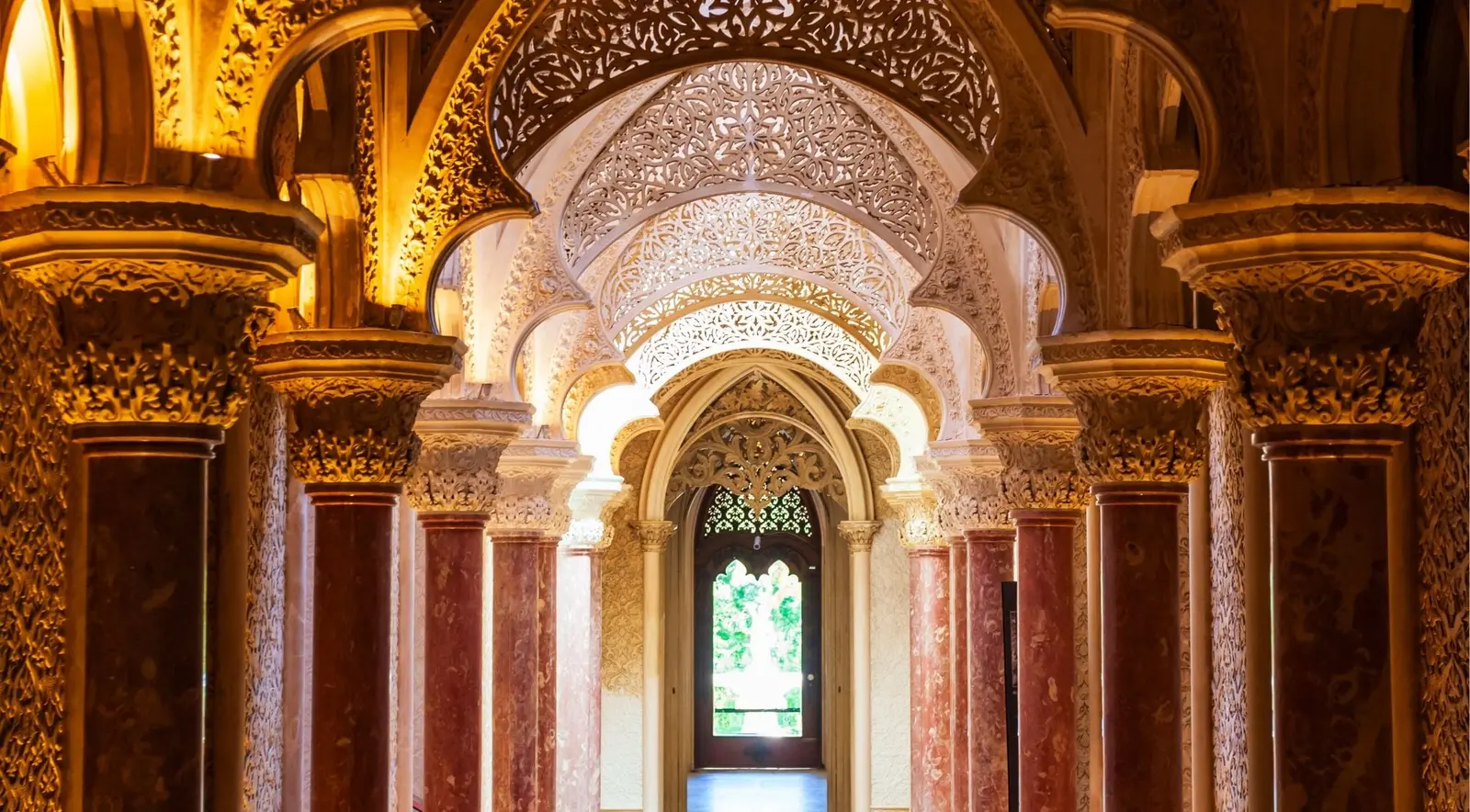
The palace is fully open in 2026 despite a major roof restoration running until the end of Q1 2027. Scaffolding covers parts of the exterior, but the carved interior — the octagonal main hall, the rose-marble columns, the Music Room — and the entire 30-hectare park are unaffected. The lawn below the building is still the best spot to photograph the three domes.
The "hidden gem" is real
Pena Palace draws over 3 million visitors a year. Monserrate reported around 200,000 by October 2025. Even in peak season, you can often have the gardens to yourself for long stretches.
Arrive any time
Unlike Pena's strict 30-minute interior slots that sell out days in advance, Monserrate requires no timed booking. Buy on arrival or online at parquesdesintra.pt and walk straight in.
One of Europe's great gardens
Winner of the 2013 European Garden Award. Mexican agaves, New Zealand tree ferns, Japanese camellias, historic roses and Beckford's 1790s romantic waterfall all within one park.
Open throughout the works
Scaffolding on the exterior until Q1 2027, but interior and all gardens remain fully accessible. The lawn below the palace is still the best vantage point for the three domes.
More Sintra Experiences You Might Enjoy
Monserrate pairs naturally with Quinta da Regaleira and Palácio de Seteais on the same 435 bus loop. Further into Sintra, Pena Palace and the Moorish Castle share the higher hilltop ridge above the town. A full day from Lisbon can weave through all of these — or focus on Pena and Monserrate together with a guide who knows both palaces and the gardens in depth. Browse live options below.
From Hermitage to Romantic Masterpiece
The story of Monserrate reads like a novel: a 16th-century chapel, an English exile's extravagant garden, a visit from Lord Byron, and a Victorian textile magnate who built one of Europe's most extraordinary palaces on the ruins.
The site began in 1540 when Friar Gaspar Preto commissioned a chapel to Our Lady of Monserrate, inspired by the Benedictine shrine of Montserrat in Catalonia. After the 1755 Lisbon earthquake left the buildings uninhabitable, wealthy English merchant Gerard de Visme leased the estate in 1789–90 and built a neo-Gothic house over the chapel ruins — reportedly the first of its style in Portugal. From 1793–94, writer William Beckford (author of the Gothic novel Vathek, living in self-imposed exile from England) sublet the property, poured money into the gardens and created the artificial waterfall by diverting a stream. When Beckford left Portugal, the estate fell back into decline.
The decisive intervention came from Sir Francis Cook (1817–1901), heir to the Cook, Son & Co. textile fortune and one of Victorian Britain's greatest art collectors. He subleased the ruin in 1856 and bought it outright in 1863. King Luís I later granted him the title Viscount of Monserrate in recognition of his investment in the estate. Cook built the present palace with architect James Knowles Jr. (construction 1858–1865) and developed the gardens with botanist William Nevill and head gardener Francis Burt until his death in 1901; his descendants extended them into the 1920s. The Portuguese state acquired the property in 1949, and management passed to Parques de Sintra in 2000, whose restoration allowed the palace to reopen to the public in 2010. It became part of the UNESCO Cultural Landscape of Sintra in 1995.
Lord Byron visited in 1809, when the Beckford estate was already a romantic ruin, and immortalised it in Childe Harold's Pilgrimage (1812): "There thou, too, Vathek! England's wealthiest son, / Once formed thy Paradise…" — "Vathek" being Byron's nod to Beckford via his novel. Alfred, Lord Tennyson visited in 1859 and Hans Christian Andersen in 1866.
An Architecture Unlike Anything Else in Portugal
Three design traditions with no natural connection — neo-Gothic, neo-Moorish and Mughal-Indian — combined into one of Europe's most original Romantic buildings.
The Octagonal Átrio Principal
The palace's most celebrated interior: lace-like carved stonework and rose-marble columns rising to a light-filled cupola. Parques de Sintra traces this octagonal hall to the earlier De Visme/Beckford house and references the Gothic period via the Founder's Chapel at Batalha. The effect is unlike any room in Europe.
The Music Room
Filling the entire northern tower, it was designed for excellent acoustics — its stucco dome carries busts of Saint Cecilia, Apollo and the Muses. It is still used for concerts today, making it a functioning room rather than a historical exhibit.
Gothic · Moorish · Mughal
The three-domed pink façade held in near-perfect symmetry, with horseshoe arches and geometric latticework drawn from the Moorish palaces of Andalusia, Mughal-Indian bulbous carved domes, and Gothic lancet arches — woven into a whole that Cook called his "Indian summer palace." An ornamental Delhi arch in the park, brought by Cook in 1857, completes the Mughal theme.
How it differs from Pena Palace: Pena (Ferdinand II's 1840s–50s hilltop fantasy) is exuberant, brightly polychromed and unmistakably a royal castle — yellow towers and red battlements crowning Sintra's highest peak. Monserrate is a lower-lying private summer villa in refined pink stone, more restrained and Orientalist, and defined as much by its gardens as its architecture. Where Pena overwhelms, Monserrate enchants.
One of Europe's Great Romantic Gardens
Winner of the 2013 European Garden Award. Cook's team exploited Sintra's cool, damp Atlantic microclimate — the sea mists that roll over the Serra — to grow species from across the British Empire that would not otherwise survive in Portugal.
Mexican Garden
Agaves, yuccas, palms and cycads in a ~5,000 m² dryland valley fed by an elaborate system of canals and water tanks. Fully restored in 2010. The warmest, driest microclimate in the park.
Fern Valley
Tree ferns from Australia and New Zealand — some towering several metres — thriving in the humid shade alongside araucarias from South America. The most otherworldly section of the park.
The Rose Garden
Historic rose varieties (many pre-1920), restored by landscape architect Gerald Luckhurst and re-inaugurated in 2011 by the then Prince of Wales and Duchess of Cornwall. Best visited May–June for peak bloom.
Beckford's Waterfall & Ruins
The 1790s artificial waterfall Beckford created by diverting a stream; a false chapel ruin slowly consumed by a rubber tree; a fake cromlech; and Vathek's Arch, named after Beckford's Gothic novel.
Go garden-first. From the ticket office, walk down to the Floresta Nativa, the Beckford waterfall, the chapel ruin, the Mexican Garden and the Rose Garden before climbing the lawns to the palace. Most of the gardens are hidden from the main building and easily bypassed if you head straight up — don't make that mistake. Allow roughly an hour for the park and half an hour inside the palace for a satisfying 1.5–2 hour total visit.
Best season: April–May for peak flowering and the Rose Garden at its best; September–October for comfortable temperatures, autumn colour and minimal crowds. Because most of the experience is outdoors, avoid rainy days — the exposed gardens and the hill between the ticket office and the palace become less pleasant in wet weather.
The Roof Restoration: What It Means for Your Visit
Full access continues throughout the works — Parques de Sintra's "open for works" policy keeps the palace and all gardens open even while scaffolding is in place.
~€3 million roof restoration
Parques de Sintra began restoring the palace's high roofs and the "Copa dos Frescos" (a vaulted service area below a southern terrace) in late 2025. The work addresses deteriorated timber roof structures and water infiltration. Estimated completion: end of Q1 2027.
Exterior scaffolding only
Scaffolding and a temporary covering are on part of the exterior — several 2026 visitors note this in reviews. The palace interior (the carved hall, the Music Room, the gallery) and all 30 hectares of gardens are fully accessible and unaffected.
Use the lower lawn
The grassed lawn about 50 metres below the palace is still the best vantage point for the three domes — the scaffolding is mostly on the upper and rear sections, less visible from this angle. Standard 2026 prices apply; no restoration discount has been announced.
Monserrate Palace: 2026 Tickets and Opening Hours
Buy at parquesdesintra.pt — no timed entry, no advance slot required. Adding other Sintra monuments to the same cart earns a multi-site discount.
| Visitor type | 2026 price | Notes |
|---|---|---|
| Adult (18–64) | €12 | Park + Palace |
| Youth (6–17) | €10 | — |
| Senior (65+) | €10 | — |
| Family (2 adults + 2 youths) | €33 | Max 4 people |
| Child under 6 | Free | Collect ticket at box office |
| Multi-site discount (2+ monuments) | 5% off | Applied when added to same cart |
Opening hours: Park 9:00–19:00 (last admission 18:00); Palace 9:30–18:00 (last admission ~17:00–17:30). The ticket office closes 12:00–13:00 for lunch, but automatic vending machines remain available. There is no timed-entry system — unlike Pena Palace, you can buy on arrival without booking a slot in advance.
Smart buying tip: If you're also visiting Pena Palace, the Moorish Castle or the National Palace, add all monuments to a single cart at parquesdesintra.pt to trigger the 5% multi-site discount. Book Pena Palace's timed slot at the same time — that's the one sight that genuinely needs advance booking. Monserrate you can almost always buy on arrival even in peak season.
How to Get to Monserrate Palace
Monserrate lies about 3.5 km west of Sintra's historic centre — a short bus ride, taxi or Bolt away. It is not walkable from the town centre for most visitors.
Bus 435 ("Villa Express")
A Scotturb hop-on-hop-off circuit from Sintra station: National Palace → Quinta da Regaleira → Seteais → Monserrate → Colares → back to station. Frequency: roughly every 30–60 min (far less reliable than the 434). Single ~€5.50; the €13.50 day pass covers both 434 and 435 loops. Reliability warning: multiple 2025–2026 traveler reports describe the 435 not running on schedule — confirm service on scotturb.com the day before, and always keep a Bolt/taxi as backup. For full details, see our Sintra transport guide.
Bolt / Uber / taxi
A reliable alternative to the 435. Station → Monserrate by Bolt typically costs €6–10 and takes about 10 minutes. On the return, order in advance — rideshare availability from Monserrate is lower than from central Sintra. Taxis at the station also serve Monserrate; agree the price before boarding.
Walk from Quinta da Regaleira
Roughly 2.3 km, about 45 minutes from Regaleira. A pleasant low-traffic route, but stretches with no pavement mean you walk on the road edge — fine for adults with care, not recommended with young children. The 435 or a Bolt are the safer option.
Combining sights: A common full-day plan is the 434 bus circuit (Moorish Castle + Pena Palace) in the morning and the 435 circuit (Quinta da Regaleira + Monserrate) in the afternoon — though given the 435's reliability issues, confirm service before committing to this schedule. Alternatively, a guided tour covering all three major palaces removes the bus logistics entirely.
Making the Most of Your Monserrate Visit
April–May or Sep–Oct
Spring for peak flowering (especially the Rose Garden and camellias); autumn for comfortable temperatures and very thin crowds. Summer works but plan for outdoor heat — Monserrate has little shade near the palace itself.
Gardens first, palace second
Walk down from the ticket office to the lower gardens (Floresta Nativa, waterfall, Mexican Garden, Rose Garden) before climbing back up to the palace. Most of the best gardens are hidden below — easy to miss if you go straight to the building.
Bundle with Pena for 5% off
Add Monserrate and Pena Palace to a single cart at parquesdesintra.pt for the multi-site discount. Book Pena's timed slot first (it sells out); Monserrate can be bought on arrival but online purchase also unlocks free rescheduling.
Pre-download Bolt and have cash
The 435 bus is convenient when it runs, but documented no-shows make it unreliable for any timed schedule. Have the Bolt app installed and a taxi number as fallback — especially for the return leg to catch a specific train.
Monserrate Palace: Frequently Asked Question
Is Monserrate Palace worth visiting in 2026 with the roof restoration works?
Yes. Parques de Sintra uses an "open for works" (aberto para obras) methodology, meaning the palace and all 30 hectares of gardens remain fully accessible throughout the ~€3 million roof restoration (expected to run until the end of Q1 2027). Scaffolding covers part of the exterior — several 2026 visitors note this in reviews — but the interior stonework, the octagonal main hall, the rose-marble columns and the Music Room are completely unaffected. The entire botanical park is also unaffected. The lawn about 50 metres below the palace is still the best vantage point for the three domes. Standard 2026 prices apply (€12 adult); no restoration discount has been announced. Once the works complete, the exterior-photography caveat disappears entirely — but the gardens and interior are the highlights regardless.